Crop Factor Calculator
Choose a sensor or enter its width and height to get the crop factor and what your lens is equivalent to on full frame.
A crop factor calculator compares your camera’s sensor with a full-frame 36 × 24 mm sensor and returns one number, the crop factor, which is 43.267 mm divided by the sensor diagonal. This camera crop factor calculator also gives the sensor diagonal, the sensor area compared with full frame, the full-frame equivalent focal length of a lens and the depth-of-field equivalent aperture.
It runs in your browser, it is free, and nothing you type is uploaded. It works in the other direction too: type a crop factor and it gives the sensor size. Use it to compare lenses across camera bodies, or to see how a lens frames on a smaller sensor.
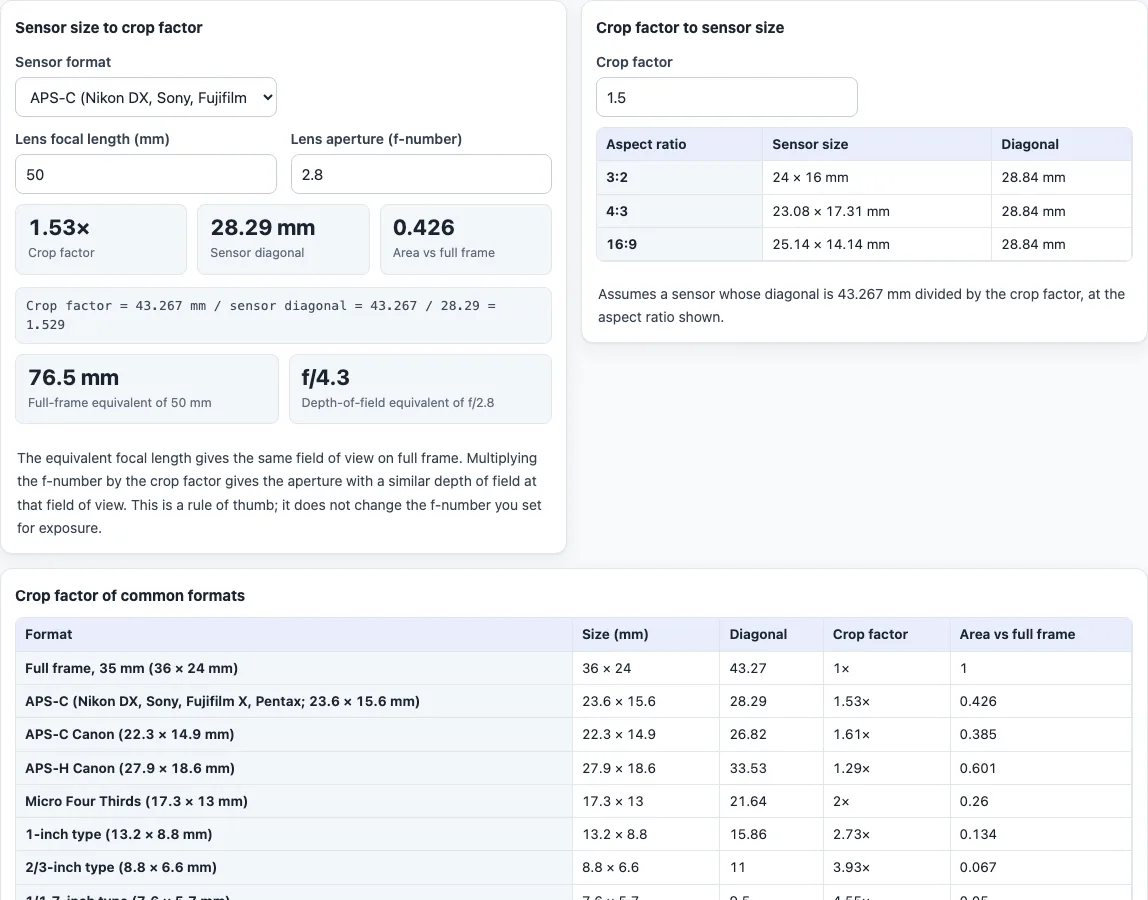
How to use the crop factor calculator
Sensor size to crop factor
- In “Sensor size to crop factor”, choose your camera in “Sensor format”. The list includes Full frame, APS-C, APS-C Canon, APS-H Canon, Micro Four Thirds, 1-inch type and smaller types, two medium formats and Super 35 film. For anything else pick “Custom size (enter width × height)” and type the sensor width and height in millimetres.
- Read “Crop factor”, “Sensor diagonal” and “Area vs full frame”. The working “Crop factor = 43.267 mm / sensor diagonal = …” is shown under them.
- To convert a lens, type the “Lens focal length (mm)” and the “Lens aperture (f-number)”. The tool shows “Full-frame equivalent of …” for the focal length and “Depth-of-field equivalent of f/…” for the aperture.
Crop factor to sensor size
- In “Crop factor to sensor size”, type a value in “Crop factor”.
- Read the table of “Aspect ratio”, “Sensor size” and “Diagonal” for 3:2, 4:3 and 16:9.
The table “Crop factor of common formats” lists all 16 formats with size, diagonal, crop factor and area against full frame.
Example: Micro Four Thirds (17.3 × 13 mm) has a diagonal of 21.64 mm and a crop factor of 2.00, with 26 % of the full-frame area. A 50 mm lens becomes 100 mm, and f/2.8 becomes f/5.6 for a similar depth of field. For the 23.6 × 15.6 mm APS-C entry the crop factor is 1.53, and 50 mm becomes 76.5 mm.
What is crop factor?
Crop factor is the ratio of a full-frame sensor’s diagonal, 43.3 mm, to the diagonal of your sensor. Full frame is 1.00 and smaller sensors are above 1. A larger number means a smaller sensor.
What is the crop factor formula?
Crop factor = 43.267 / sensor diagonal, where the diagonal is √(w² + h²) in millimetres. For 23.6 × 15.6 mm the diagonal is 28.29 mm, so the crop factor is 43.267 / 28.29 = 1.53. The diagonal is used because it captures width and height in one number.
What is the APS-C crop factor, and the Canon crop factor?
With the nominal sizes in the list, “APS-C (Nikon DX, Sony, Fujifilm X, Pentax; 23.6 × 15.6 mm)” gives 1.53 and “APS-C Canon (22.3 × 14.9 mm)” gives 1.61. APS-H Canon gives 1.29, and Super 35 film gives 1.52 for 3-perf and 1.39 for 4-perf. These are computed from the sizes shown, so they can differ in the last digit from rounded values quoted elsewhere. Sensor sizes also vary a little between camera models.
What does “Area vs full frame” mean?
It is the sensor width times height divided by 864 mm², the area of 36 × 24 mm. APS-C (23.6 × 15.6 mm) is 0.426 of full frame, Micro Four Thirds 0.260 and the 1-inch type 0.134. It is not exactly 1 divided by the crop factor squared unless the sensor is 3:2, so the tool computes it from the real width and height.
What is the equivalent focal length?
It is the focal length times the crop factor, the focal length that gives the same field of view on full frame. A 50 mm lens on APS-C Canon behaves like 80.7 mm. The lens itself does not change.
What is the depth-of-field equivalent aperture?
The tool multiplies the f-number by the crop factor to give the aperture with a similar depth of field at that field of view. This is a rule of thumb. It does not change the f-number you set for exposure. The tool does not show an ISO equivalent, because there is no formula to cite for it.
What does the “Crop factor to sensor size” table assume?
It assumes the sensor diagonal is 43.267 mm divided by the crop factor, at each aspect ratio shown. A crop factor of 1.5 gives 24 × 16 mm at 3:2, 23.08 × 17.31 mm at 4:3 and 25.14 × 14.14 mm at 16:9.
Frequently asked questions
Is the crop factor calculator free, and is anything uploaded?
It is free and needs no account. Everything runs in your browser, and nothing you type is uploaded.
What is a crop factor of 1?
A full-frame 36 × 24 mm sensor. Its focal length is unchanged when converted.
Does a higher crop factor mean a worse camera?
The crop factor only describes sensor size relative to full frame. It says nothing about other camera features.
Why does my crop factor differ from a table I found?
Tables round their values and sensor sizes vary slightly between models. This tool computes the factor from the exact width and height shown or typed.
Can I calculate a crop factor for a cinema camera such as a Blackmagic or RED?
The list has no cinema digital rows. Choose “Custom size (enter width × height)” and type the sensor dimensions from the camera’s specification to get its crop factor, diagonal and equivalents.
Does the equivalent focal length change the lens?
No. The lens keeps its focal length. The equivalent only tells you which full-frame lens would give the same framing.
What does the calculator use as full frame?
A 36 × 24 mm sensor, which has a diagonal of 43.267 mm. Every crop factor on the page is that diagonal divided by the diagonal of the sensor you choose.
Can I use it for film cameras?
The list includes Super 35 film and two medium formats. For any other film gate or format, choose “Custom size (enter width × height)” and type its dimensions in millimetres.
Related tools
- Depth of field calculator uses the sensor to give near, far and total depth of field.
- Hyperfocal distance calculator gives the hyperfocal distance for your sensor and lens.
- Field of view calculator gives the angle and scene size for a lens and sensor.
- Angle of view calculator converts between focal length and angle of view.
- Telescope field of view calculator gives the field of view and image scale for a camera on a telescope.
- Sensor size comparison draws two sensors to scale with the area ratio and stops of light.