Photo Backdrop Sizes
A chart of common backdrop sizes in four units, and a calculator for the backdrop you need behind your subject.
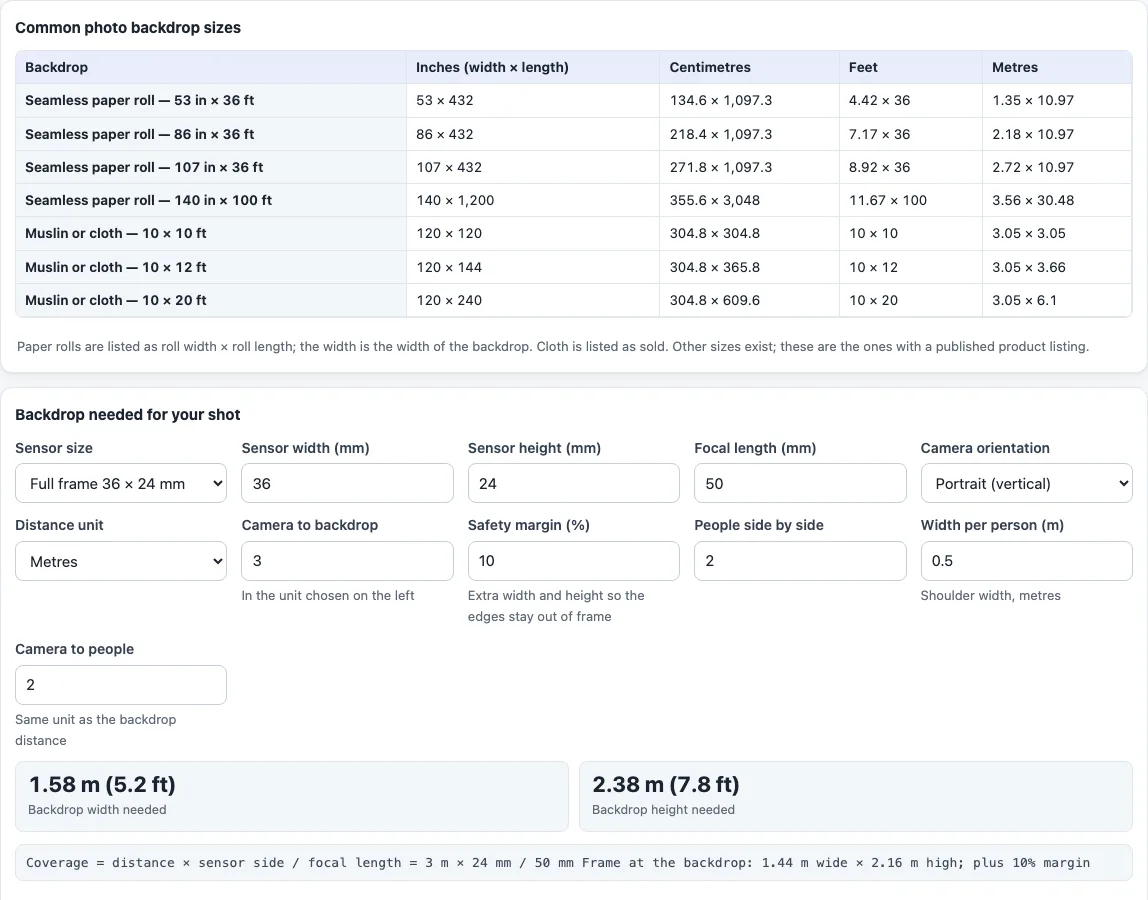
Photo backdrop sizes in the chart on this page are seamless paper rolls 53, 86, 107 and 140 inches wide, and muslin or cloth sheets of 10 × 10 ft, 10 × 12 ft and 10 × 20 ft. Each size is listed in inches, centimetres, feet and metres, and a calculator tells you the backdrop width and height your lens, distance and group need.
These are the sizes with a published product listing; other sizes exist. Use the chart to pick a backdrop before you buy, then use the calculator to check whether that width and height covers your shot. The page runs in your browser, it is free, and nothing you type is uploaded.
How to use the photo backdrop size chart
- Read the table “Common photo backdrop sizes”. “Inches (width × length)”, “Centimetres”, “Feet” and “Metres” give the same size in four units. For a paper roll the width is the width of the backdrop and the length is the roll. Cloth is listed as sold.
- For the size you need, go to “Backdrop needed for your shot”. Choose a “Sensor size” (full frame, APS-C, APS-C (22.3 mm type), Micro Four Thirds) or “Custom (type the two sizes)” and fill in “Sensor width (mm)” and “Sensor height (mm)”.
- Enter the “Focal length (mm)” and choose the “Camera orientation”: “Portrait (vertical)” or “Landscape (horizontal)”.
- Choose the “Distance unit” and enter “Camera to backdrop”.
- Set the “Safety margin (%)”. It adds extra width and height so the edges stay out of frame. The default is 10, and you can change it.
- Read “Backdrop width needed” and “Backdrop height needed”, then the list “Listed sizes that cover this:”. If nothing is large enough, move the camera closer to the backdrop, use a longer lens or reduce the margin.
- To check a group, fill in “People side by side”, “Width per person (m)” and “Camera to people”. The tool says how much of the frame width they fill.
What are the standard photo backdrop sizes?
No single size is the standard backdrop size in the sources used here, so the chart lists what is sold. Seamless paper: 53 in × 36 ft (134.6 cm × 10.97 m), 86 in × 36 ft, 107 in × 36 ft and 140 in × 100 ft (355.6 cm × 30.48 m). Muslin or cloth: 10 × 10 ft (3.05 × 3.05 m), 10 × 12 ft and 10 × 20 ft (3.05 × 6.10 m).
Pictureline’s Seamless Paper Size Guide lists the 53 in roll for portraits, headshots and commercial photography, the 107 in roll for full body, couples, small groups and medium to large products, and the 140 in roll for large groups, large products and models who need to move. The 86 in size comes from a retailer listing, not from that guide. The sources list is in the collapsed section “Where the sizes come from”.
How big a backdrop do you need for a photo?
The width of scene your lens sees at the backdrop is distance × sensor side / focal length. The tool takes the frame width and height from the sensor’s two sides, swapping them for portrait, then adds the margin.
With a full-frame sensor (36 × 24 mm), a 50 mm lens and the backdrop 3 m away, the frame is 1.44 m wide and 2.16 m high in portrait, and 2.16 m by 1.44 m in landscape. With the default 10 % margin the portrait frame needs a backdrop of 1.58 m × 2.38 m. A 35 mm lens at the same distance sees 3.09 m × 2.06 m.
Which listed sizes cover the frame?
A paper roll covers the frame if its width is at least the width needed and its length is at least the height needed. A cloth sheet covers it in either orientation. For the portrait example above, 86 in (2.18 m) paper covers the width and 53 in (1.35 m) paper does not. In landscape the same shot needs 2.38 m of width, so 86 in paper is too narrow and 107 in (2.72 m) paper covers it.
What backdrop size fits a group?
Enter the number of people, a width per person and their distance from the camera. The tool compares the width of the group with the width of the frame at that distance and reports the percentage. With the defaults, 2 people at 0.5 m each and 2 m from a 50 mm lens on full frame in portrait, the group is 1 m across a frame 0.96 m wide, so the tool warns that they would fill 104% of the width. Step back or use a wider lens.
What about 5x7, 8x8 or 8x10 ft backdrops?
The chart does not list 3x5, 5x7, 7x5, 8x8 or 8x10 ft backdrops, because no product source was found for those sizes and none are shown without one. To check a size you are thinking of buying, run your shot through the calculator and compare the width and height needed with the size on the product page.
The calculator gives only the size needed in the frame. It does not add length for a floor sweep, subject separation or zoom breathing.
Frequently asked questions
Are the photo backdrop size chart and calculator free?
Yes. Both are free, need no account and run in your browser. Nothing you type is uploaded.
What size photo backdrop do I need for headshots?
Pictureline’s guide lists the 53 in × 36 ft paper roll for portraits and headshots. Your lens and distance decide how much backdrop you actually need, so check the frame with the calculator.
What is the average size of a photo backdrop?
The sources here do not give an average. The chart lists the paper and cloth sizes that are sold, from 53 in wide paper to 10 × 20 ft cloth.
What size backdrop for a full-length group?
Pictureline lists the 107 in roll for full body, couples and small groups, and the 140 in roll for large groups. Run the calculator with your group, lens and distances to see what your frame needs.
How do I convert backdrop dimensions between inches, cm, feet and metres?
The table already shows each size in all four. The conversions are 1 in = 2.54 cm and 1 ft = 12 in, so 107 in is 271.8 cm, 8.92 ft or 2.72 m.
Does the stand matter?
Yes. Pictureline says a stand with a cross bar of 9 ft or longer carries 53 to 107 in paper. Check the limits of your own stand.
Related tools
- Field of view calculator: the width and height your lens covers at a given distance.
- Angle of view calculator: the angle a lens covers from its focal length and sensor size.
- Crop factor calculator: how a sensor size changes the coverage of a lens.
- Depth of field calculator: how much of the scene stays sharp at an aperture and distance.