Sensor Size Comparison
Pick two sensors to see them drawn to scale with their area ratio, stops of light and the lens that matches the view.
A sensor size comparison puts two camera sensors next to each other so you can see how much bigger one is. Choose any two formats, from full frame and APS-C to Micro Four Thirds, 1-inch and medium format, or type your own width and height. The tool draws them to scale, one inside the other, and gives the area ratio, the difference in stops of light, the crop factor of each and how much one crops the other. This is the quick way to answer crop sensor vs full frame.
It runs in your browser, it is free, and nothing you type is uploaded. Enter a lens on sensor A and it shows the focal length and aperture that give the same view and similar depth of field on sensor B. It compares size only: it does not judge noise, dynamic range or resolution.
How to use the sensor size comparison
- Under “Sensor A (blue)”, choose a format, for example “Full frame, 35 mm (36 × 24 mm)”. Pick “Custom size (enter width × height)” to type “Sensor A width (mm)” and “Sensor A height (mm)”.
- Under “Sensor B (orange, dashed)”, choose the second format, for example “APS-C” or “Micro Four Thirds”. Custom sizes work the same way.
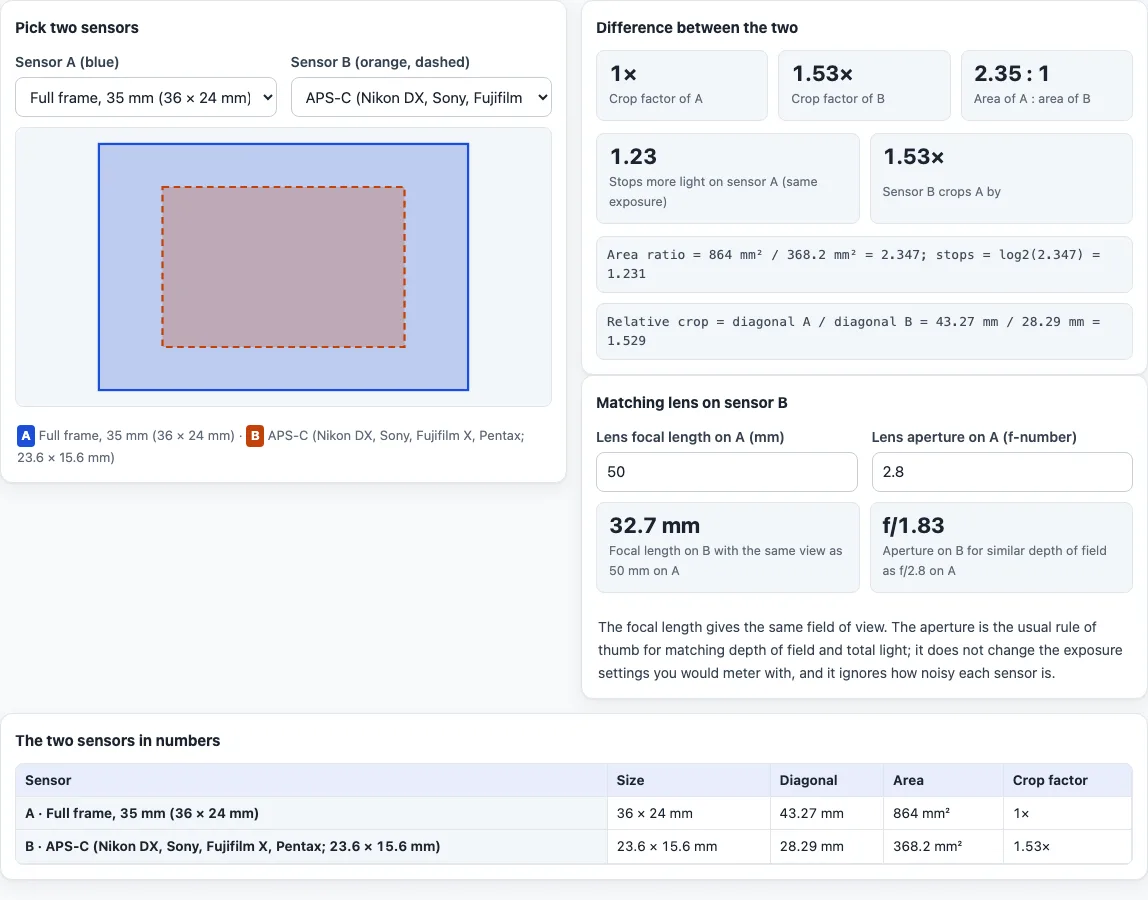
- Look at the drawing: both sensors are scaled to the same page, and the smaller one sits inside the larger.
- Read “Crop factor of A”, “Crop factor of B” and “Area of A : area of B”. Below them, “Stops more light on sensor A (same exposure)” tells you the log base 2 of the area ratio, and “Sensor B crops A by” gives the relative crop factor.
- In “Matching lens on sensor B”, type the “Lens focal length on A (mm)” and “Lens aperture on A (f-number)”. The results are the focal length on B with the same view and the aperture on B for similar depth of field.
- Check the table “The two sensors in numbers” for the exact sizes, diagonals and areas.
Example: full frame against APS-C (23.6 × 15.6 mm). The area ratio is 2.35 to 1, which is 1.23 stops, and APS-C crops full frame by 1.53×. A 50 mm f/2.8 lens on full frame matches about 32.7 mm f/1.83 on APS-C.
What is the difference between a crop sensor and a full-frame sensor?
A full-frame sensor measures 36 × 24 mm, the size of a 35 mm film frame. A crop sensor is any smaller one, such as APS-C at about 23.6 × 15.6 mm or Micro Four Thirds at 17.3 × 13 mm. The crop factor is 43.267 mm, the full-frame diagonal, divided by the sensor diagonal. A smaller sensor sees a narrower part of the image a lens projects, so the same lens looks more zoomed in.
How many stops of light is the area difference?
At the same f-number and shutter time, a sensor collects light in proportion to its area, so the difference in stops is the log base 2 of the area ratio. Full frame against APS-C is 864 mm² against 368 mm², a ratio of 2.35, or 1.23 stops. A 4 to 1 ratio is exactly 2 stops. This compares total light, not image quality: pixel size, sensor design and processing also matter, and the tool does not include them.
How do I match the lens on a different sensor?
Divide the lens focal length by the relative crop factor to get the same field of view, or multiply it when you go to a larger sensor. A 50 mm lens on full frame frames like 50 ÷ 1.53 = 32.7 mm on APS-C. Scaling the f-number by the same factor is a common rule of thumb for similar depth of field and total light, so f/2.8 becomes f/1.83. It is only a guide, and it does not change the exposure settings you would meter with.
Where do the sensor sizes come from?
The format list uses nominal sizes from Wikipedia’s articles on image sensor formats and crop factor, shared with the crop factor calculator on this site. Real sensors vary a little between camera models, so choose “Custom size” if you know the exact dimensions from your camera’s data sheet.
Sources
- Wikipedia, Image sensor format and Crop factor (read 15 Oct 2026) — nominal sensor sizes and the 43.267 mm full-frame diagonal.
- Area ratio, stops and relative crop are arithmetic on the sizes shown.
Frequently asked questions
What is the size difference between APS-C and full frame?
Full frame is 36 × 24 mm and APS-C is about 23.6 × 15.6 mm, so full frame has 2.35 times the area and a diagonal 1.53 times longer. Pick both formats in the tool to see them to scale.
Does a bigger sensor always give a better picture?
A bigger sensor collects more total light at the same settings, but picture quality also depends on the pixels, lens and processing. This tool shows size and light only.
How many stops more light does full frame get than APS-C?
About 1.23 stops, which is the log base 2 of the 2.35 area ratio.
What is the crop factor of Micro Four Thirds?
About 2.0, because its 17.3 × 13 mm sensor has a diagonal half that of full frame. Choose it as sensor B to see the number and the matching lens.
Can I compare a sensor that is not in the list?
Yes. Choose “Custom size (enter width × height)” for sensor A or B and type the width and height in millimetres.
Why does a smaller sensor make the same lens look more zoomed in?
The lens projects the same image circle, and a smaller sensor records only the central part of it. That part fills the frame, so the view is narrower by the relative crop factor.
Is my data uploaded anywhere?
No. The tool runs in your browser, nothing you type is uploaded, and it is free.
Related tools
- Crop factor calculator gives the crop factor of one sensor and a table of formats.
- Field of view calculator gives the angle and scene size for a lens and sensor.
- Angle of view calculator converts between focal length and angle of view.
- Depth of field calculator gives near, far and total depth of field.